

Rethinking SAP CDC in Azure: What recent SAP’s ODP enforcements mean for your data platform.
If your organization relies on the Azure Data Factory (ADF) SAP CDC connector to extract data from SAP, now is the time to reassess your data ingestion strategy.
For years, the connector offered a pragmatic and efficient way to move SAP data into Azure platforms by leveraging SAP’s Operational Data Provisioning (ODP) framework. It enabled organizations to extract delta changes from SAP systems and feed modern cloud data platforms without having to build complex custom extraction mechanisms. And for many companies, it simply worked. But the legal landscape is evolving.
Starting June 2026, SAP will enforce stricter controls around third-party access to the ODP framework. What was previously loosely governed is now becoming actively restricted through technical enforcement delivered via SAP security patches.
This is more than just a technical change. It forces you to reconsider how SAP data should be ingested into your Modern Data Platform in a sustainable and compliant way.
In this article, we briefly revisit how the SAP CDC connector in Azure Data Factory works, explain what exactly is changing from SAP’s side, and outline the practical implications for your existing architecture. More importantly, we explore why this moment can also be seen as an opportunity: a chance to rethink legacy extraction patterns and move toward a more modern, scalable, and future-proof SAP data integration strategy.
1. What is the Azure Data Factory (ADF) CDC Connector
Companies dealing with large operational datasets such as financial documents, sales orders, or logistics transactions often require a mechanism that can efficiently extract only the changes made since the previous load. Instead of repeatedly transferring complete datasets, the objective is to retrieve incremental changes only: inserts, updates, and deletions. This is where Change Data Capture (CDC) becomes essential.
The Azure Data Factory SAP CDC connector is a Microsoft-built integration capability designed to extract incremental changes from SAP systems by leveraging the SAP Operational Data Provisioning (ODP) framework and loading this data into Azure-based platforms such as Data Lakes or analytical environments. Rather than performing full extractions on every execution, the connector retrieves only the delta records generated since the previous extraction cycle, significantly reducing data volume, network traffic, and extraction runtime.
At the core of this mechanism is the SAP ODP framework. ODP was introduced by SAP to standardize operational extraction and replication scenarios across multiple (SAP) applications and technologies. It provides built-in delta handling capabilities, allowing SAP systems to track only the changed records.
In a delta-enabled extraction scenario, the source system, also referred to as the ODP Provider, automatically writes changes into a delta queue through SAP-managed update processes. Consumer applications, such as Azure Data Factory, subsequently read these queued changes and process them further downstream. This architecture enables controlled and repeatable incremental extraction patterns without requiring custom delta logic to be implemented externally.
One of the major strengths of the SAP CDC connector is that it does not only support extraction from physical SAP tables. By relying on the ODP framework, it can consume multiple SAP source object types, including logical and semantically enriched datasets already exposed by SAP. Supported source types include:
- SAP extractors, originally designed to transfer data from SAP ECC into SAP BW environments
- ABAP CDS Views, which represent SAP’s strategic extraction framework for SAP S/4HANA
- InfoProviders and InfoObjects from SAP BW and SAP BW/4HANA
- SAP application tables exposed through SAP Landscape Transformation Replication Server (SLT)
This flexibility makes the connector particularly attractive for organizations looking to accelerate SAP-to-Azure integrations without having to redesign existing extraction logic from scratch.
Within this architecture, the SAP data sources act as ODP Providers. These providers generate either full datasets or incremental delta records and expose them operationally through the ODP framework, allowing external consumers such as Azure Data Factory to retrieve the data in a standardized manner.
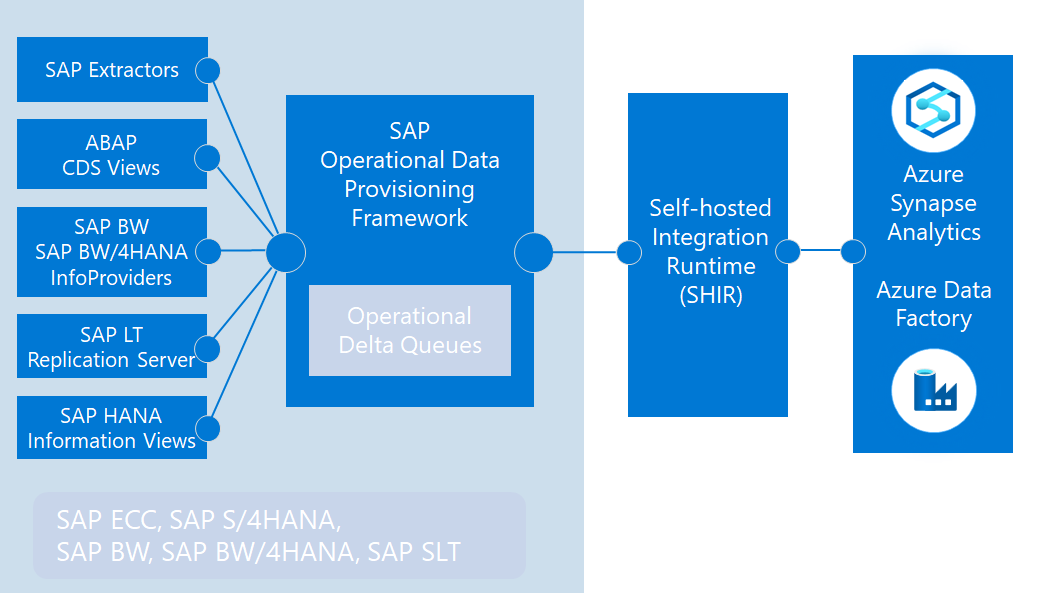
No doubt, the CDC connector hooks directly into ODP and that is precisely where the new SAP rules come into play.
2. What it is NOT? Don't confuse it with the ADF Table Connector
So often, the SAP CDC connector is seen as a strategic bridge between SAP and Azure, but in practice it is more of a tactical decision to move SAP logic quickly into a cloud platform. Don’t misuse the SAP CDC connector...
2.1 The Azure Data Factory SAP CDC Connector is not a replacement for SAP extractor governance
The SAP CDC connector does not eliminate the need for proper SAP-side governance and operational ownership. Organizations still remain dependent on traditional SAP extraction concepts such as BW extractor lifecycle management, SAP authorizations, transport management, and ODP queue monitoring. Changes to extractors, delta mechanisms, or authorization models still require coordination with SAP Basis and BW teams. As a result, the connector does not reduce the operational dependency on SAP, it simply shifts the consumption layer to Azure.
2.2 The Azure Data Factory SAP CDC Connector is (& never was) not a future-proof strategic integration path
The SAP CDC connector is often adopted as a fast-track solution to ingest SAP data into Azure, but it is not always aligned with a modern data platform principles.
Many SAP extractors were originally designed for SAP BW-centric reporting scenarios and therefore contain pre-defined business logic, aggregations, and tightly coupled semantics. In a modern cloud data platform, the objective is usually to decouple this logic into reusable facts, dimensions, and domain-oriented models that can evolve independently.
By directly replicating extractor-based logic into Azure with the SAP CDC connector, organizations risk inheriting legacy modelling patterns that limit flexibility, reusability, and long-term scalability.
2.3 The Azure Data Factory SAP CDC Connector still impacts the SAP application layer
Although the connector is frequently perceived as a lightweight extraction mechanism, it still introduces load on the SAP landscape. CDC extraction places pressure on application servers, memory consumption, and ODP queue management.
At a larger scale, or with high-frequency delta loads, organizations may experience increased queue growth, longer extraction runtimes, and additional monitoring requirements.
So, it is important to distinguish the CDC connector from the ADF Table connector. The Table connector performs a straightforward full or filtered read of a SAP table using RFC/BAPI calls, without using the ODP framework, and it is not subject to the same upcoming restrictions. Confusing the two could lead you to either unnecessary panic or, worse, a false sense of security.
3. The context: What SAP is changing and why
For years, the ADF SAP CDC connector became one of the most pragmatic ways to move SAP data into Azure. It solved a very concrete problem: organizations wanted efficient delta extraction from SAP systems without having to build custom extraction frameworks themselves. And for many companies, it worked remarkably well.
Data engineering teams could quickly ingest large SAP datasets into their modern cloud platforms while avoiding costly full loads. Then came early 2024, when SAP published SAP Note 3255746 with a clear and explicit message: the use of ODP-RFC for third-party tools was no longer permitted unless properly licensed and certified by SAP. The note clarified that the RFC modules behind ODP data replication were intended exclusively for communication between SAP applications and SAP-approved technologies.
This was not just a technical clarification. It was a strategic statement from SAP.
The ODP framework had originally been designed for SAP’s own ecosystem, powering integrations with technologies such as SAP BW, SAP Data Services, and then SAP Datasphere. Over time, external vendors such as Microsoft started leveraging the same framework in their own connectors and integration services. As adoption grew, SAP introduced stricter governance around how ODP could be accessed by non-SAP platforms.
The message from SAP became increasingly clear: third-party usage of ODP required explicit authorization, licensing, and certification. Any unapproved usage was considered non-compliant with SAP’s terms and conditions.
Still, despite the publication of the note, very little changed during the following two years. Many organizations continued using the SAP CDC connector in Azure Data Factory exactly as before. Existing pipelines kept running, delta extractions continued to function, and for most teams there was no immediate technical impact.
But under the surface, the situation was evolving... SAP gradually shifted from policy communication toward technical enforcement. Updated guidance and additional SAP Notes clearly highlighted that the company was preparing to actively restrict unauthorized ODP-RFC usage. What initially looked like a contractual or licensing concern is now becoming a concrete operational risk for data platforms relying on these connectors.
The turning point now comes with the upcoming SAP security patch scheduled for June 2026. SAP Note 3439624 introduces a self-assessment mechanism allowing organizations to audit their current ODP-RFC usage across the SAP landscape and identify unauthorized consumers. More importantly, SAP announced that starting from June 9th, 2026, technical enforcement will be activated through security patches that block unauthorized RFC calls to ODP replication modules.
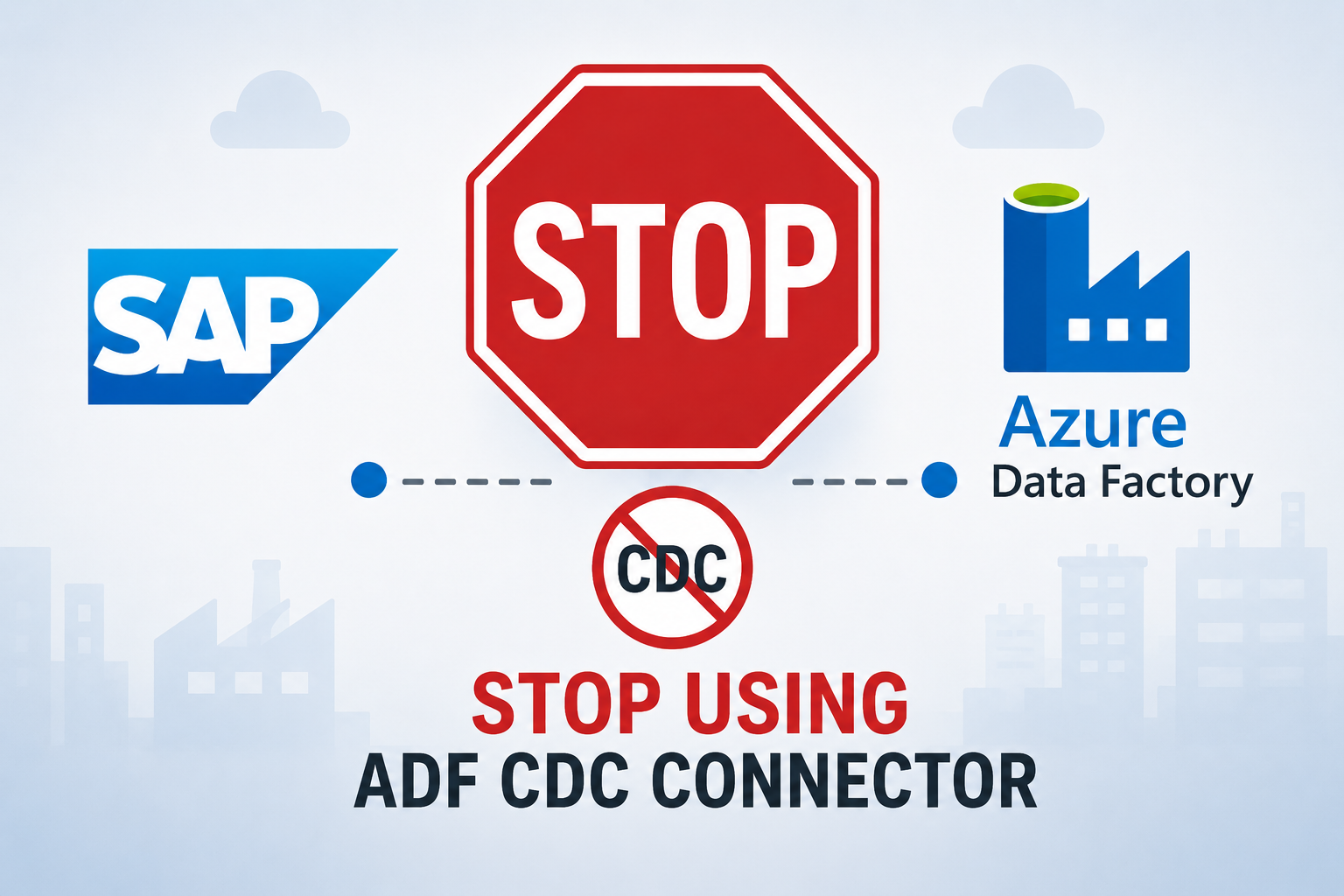
As of June 2026, the SAP policy stops being a theoretical governance discussion. Organizations who are continuing to rely on unsupported ODP-RFC integrations risk not only compliance issues, but also direct disruption of critical SAP-to-Azure data pipelines. It might just stop working... What was once considered a convenient integration shortcut is now forcing many enterprises to reassess their long-term SAP extraction strategy.
4. What this means in practice: what is no longer allowed, what still is
The upcoming SAP security enforcement around ODP-RFC requires organizations to take concrete actions IF you are currently relying on the Azure Data Factory SAP CDC connector.
A practical approach can be broken down into three steps.
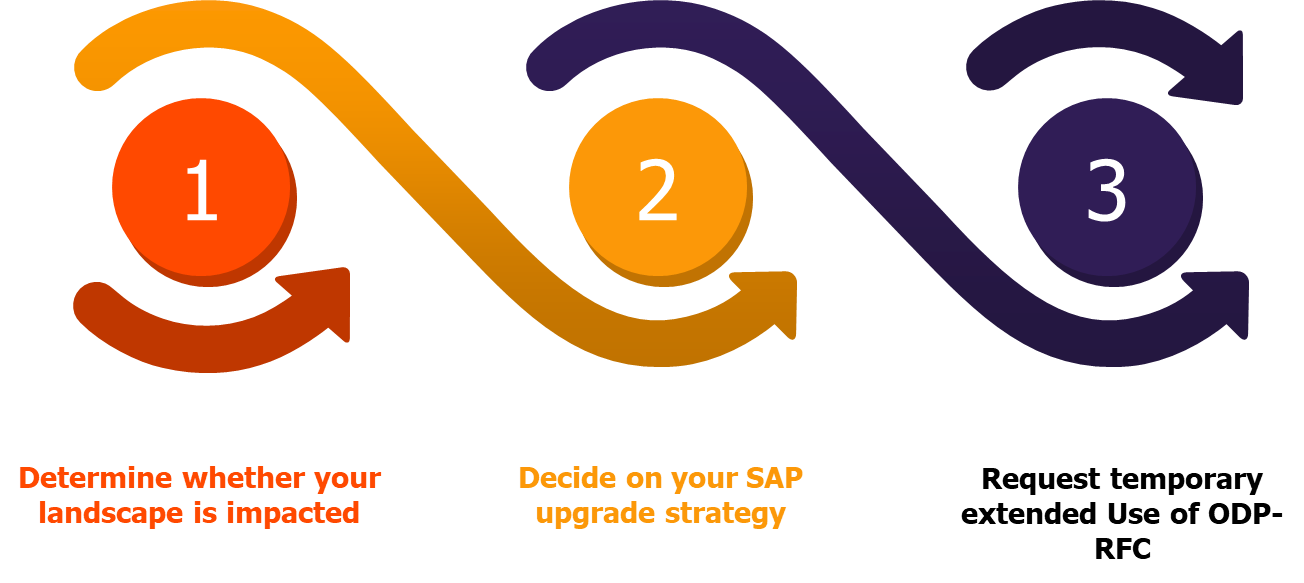
- Step 1: Determine whether your landscape is impacted
The first priority is to assess whether your SAP systems currently use unauthorized ODP-RFC integrations. SAP Note 3439624 provides a self-assessment mechanism that can be implemented through transaction SNOTE. Once activated, the tool monitors and analyses how ODP-RFC modules are being consumed across the SAP landscape. This allows organizations to identify existing third-party integrations, including Azure Data Factory CDC scenarios, that may become non-compliant after the upcoming security enforcement. We are here to help...
- Step 2: Decide on your SAP upgrade strategy
Second, if you are impacted: strategize. Starting from June 9th, 2026, SAP will integrate the new ODP-RFC security restrictions into subsequent Support Packages. Once these support packages are applied during system maintenance or upgrades, unauthorized ODP-RFC calls will be technically blocked. In practice, this means that existing third-party replication scenarios may stop functioning immediately after the upgrade.
This creates an important strategic decision for SAP teams:
- OR Delay upgrades temporarily to preserve operational continuity
- OR Proceed with upgrades and accelerate migration toward compliant extraction approaches
While postponing upgrades may buy time, it also introduces operational and security considerations. Organizations therefore need to carefully balance platform stability, compliance, and long-term architecture goals.
- Step 3: Request temporary extended Use of ODP-RFC
SAP is clearly aware that many organizations still depend on ODP-RFC-based integrations for operational reporting and cloud analytics platforms. Because of this, SAP announced a temporary fallback mechanism that would allow customers to re-enable unrestricted ODP-RFC usage until December 2026.
At the time of writing, the detailed implementation guidelines are still expected to be published in the related SAP Notes. However, this temporary extension should not be viewed as a permanent solution. It is primarily intended to provide organizations with additional time to redesign or migrate existing integrations toward supported alternatives.
The broader message from SAP remains unchanged: access to the ODP framework is becoming tightly controlled and limited to approved usage scenarios.
This official SAP F.A.Q. provides comprehensive guidance and clarification on the recent updates and enforcement changes related to the ODP-RFC SAP notes.
5. What are the alternatives? Where can element61 help you
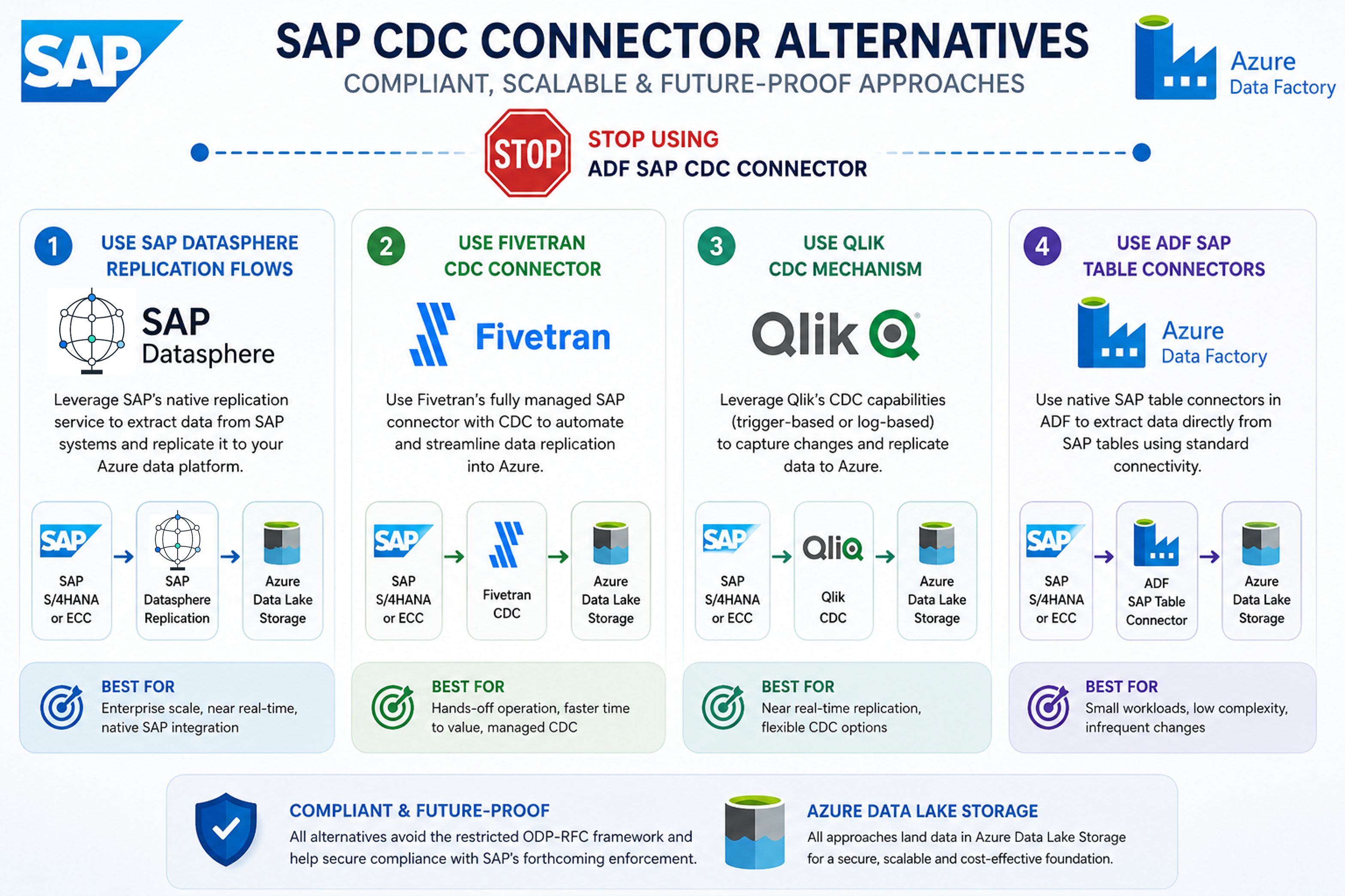
There are several viable paths forward depending on your architecture and SAP landscape. SAP Business Data Cloud (BDC) SAP's own preferred answer, offering native ODP access and tight integration with SAP data. For organizations that want to stay in the Microsoft ecosystem, there are certified alternatives and architectural patterns that achieve the same incremental data extraction goals without relying on the ADF CDC connector. As a partner with deep expertise in both SAP and Azure data platforms, we help organizations navigate exactly these transitions: assessing your current extraction landscape, identifying risk exposure, and designing a compliant, future-proof architecture.
5.1 You can use SAP Datasphere as a compliant pass-through
One of the most obvious alternatives emerging from SAP’s ODP restrictions is the use of SAP Datasphere Replication Flows. From SAP’s perspective, this is the strategic and fully compliant path forward for operational data replication scenarios. We would suggest leveraging SAP Datasphere as a passthrough layer, moving your data from SAP sources to Azure in a compliant way.
In this setup, SAP Datasphere orchestrates and governs the replication process, defining what data is extracted, how it is replicated, and where it should land. However, the actual data persistence does not necessarily happen inside Datasphere itself. Instead, the replicated data can be written directly into Azure Data Lake Storage Gen2.
Concretely, the process is relatively straightforward. Within SAP Datasphere, replication flows are created through a low-code or no-code interface. The source can be an SAP system such as SAP S/4HANA, SAP ECC, or SAP BW/4HANA, while the target can be Azure Data Lake Storage. Datasphere then orchestrates the extraction and replication process using SAP-supported connectivity and SAP-governed access to the ODP framework.
This distinction is critical. Unlike the Azure Data Factory CDC connector, which accessed ODP-RFC interfaces from outside the SAP ecosystem, Datasphere is part of SAP’s strategic data stack and therefore remains fully aligned with SAP’s licensing and support model. And Datasphere remains one of the officially supported consumers of ODP.
From an extraction perspective, this approach still provides access to many of the same SAP data sources organizations relied on previously, including:
- ABAP CDS Views in SAP S/4HANA
- SAP extractors originally built for SAP BW scenarios
- BW InfoProviders and InfoObjects in SAP BW and BW/4HANA
- Delta-enabled operational datasets exposed through ODP
This is particularly important for organizations that already invested heavily in SAP extractor logic. Existing BW extractors and delta mechanisms can often still be reused through Datasphere replication flows, preserving years of SAP business logic and operational modelling.
At the same time, organizations should carefully evaluate whether they want to continue propagating legacy extractor semantics into their modern cloud platform. Many traditional SAP extractors contain tightly coupled business rules, transformations, and aggregation logic designed for BW-centric reporting architectures.
Architecturally, the Datasphere replication flow approach offers an interesting middle ground:
- SAP remains responsible for compliant ODP access and operational governance
- Azure continues to provide scalable and cost-efficient storage and downstream analytics
- Existing SAP extraction assets can often be reused
- Data persistence inside Datasphere itself can be minimized or avoided entirely
This means organizations can combine SAP-aligned extraction capabilities with the scalability of Azure, without necessarily turning Datasphere into yet another centralized storage platform.
5.2 You can use Fivetran CDC as an ODP-independent extraction approach
Another increasingly relevant alternative is using Fivetran as the ingestion layer between SAP systems and Azure. In the context of SAP’s tightening restrictions around the ODP framework, this approach is particularly interesting because it fundamentally avoids direct dependency on ODP-RFC altogether.
From a technical perspective, Fivetran provides a managed Change Data Capture mechanism that abstracts the complexity of delta extraction from SAP systems. Instead of relying on SAP’s ODP queues, RFC-based extraction, or extractor frameworks, Fivetran uses its own ingestion patterns depending on the connector type.
Once an initial full load is performed, Fivetran automatically establishes CDC for incremental updates. The platform continuously monitors source changes and propagates inserts, updates, and deletes into the target system. Synchronisation frequency can be configured depending on latency requirements, ranging from near-real-time (every minute) to scheduled batch intervals (up to 24 hours).
A key capability in this context is how Fivetran handles data lifecycle changes, particularly deletions and archiving. To ensure proper change tracking, Fivetran has introduced its own metadata columns. This is especially important in SAP landscapes where data lifecycle semantics are not always aligned with cloud-native CDC expectations.
From a connectivity standpoint, Fivetran offers multiple SAP integration patterns that are relevant in the current compliance context:
- The Fivetran OData connector, which leverages SAP’s OData services rather than the ODP framework
- The SAP ERP on HANA connector, which is based on an ABAP add-on deployed inside the SAP system and does not rely on ODP-RFC extraction mechanisms
Fivetran’s architecture is largely unaffected by the ongoing restrictions because it does not depend on ODP as its primary extraction mechanism. Instead, it uses SAP-supported interfaces such as OData services or internal ABAP-based extraction layers that remain within SAP’s supported integration boundaries. Hence, it reduces exposure of organizations using Fivetran, to upcoming enforcement actions planned for June 2026. This positions Fivetran as a more resilient ingestion option in a landscape where direct ODP consumption is becoming tightly controlled.
At the same time, the managed nature of Fivetran CDC brings operational benefits:
- Reduced need for SAP-side extractor maintenance
- Built-in schema drift handling and monitoring
- Automated CDC management without ODP queue dependencies
- Faster onboarding of SAP sources compared to traditional extraction pipelines
For organizations already using Fivetran with SAP, the current SAP policy changes do not impact existing extraction mechanisms. Pipelines continue to operate normally, data replication remains uninterrupted, and SAP data can still be delivered in a compliant way to the target platform. Fivetran also continues to actively monitor the evolving SAP policy landscape and engage with SAP to ensure long-term supportability for its customers.
5.3 You can use Qlik CDC for SAP Replication
Another strong alternative is leveraging Qlik’s Change Data Capture (CDC) capabilities to replicate SAP data into Azure platforms. Similar to Fivetran, this approach avoids direct dependency on the SAP ODP-RFC framework, making it less exposed to SAP’s upcoming enforcement restrictions.
Qlik provides automated CDC mechanisms that continuously capture and replicate changes from SAP systems without requiring repeated full loads. Depending on the source technology and architecture, Qlik supports both trigger-based CDC and log-based CDC approaches.
- With trigger-based CDC, Qlik deploys database triggers on relevant SAP tables. These triggers capture every insert, update, or delete operation and write the changes into dedicated change tables. Qlik subsequently reads these change tables at regular intervals and replicates the deltas to the target platform, enabling near-real-time synchronization while significantly reducing load compared to full extraction scenarios.
- For SAP HANA environments, Qlik can also leverage log-based CDC. In this setup, Qlik reads changes directly from the SAP HANA database logs instead of deploying triggers on the source tables. This approach is generally faster, introduces a smaller system footprint, and reduces operational overhead on the source application. However, it is important to note that SAP does not officially support log-based replication on HANA databases, which should be carefully evaluated from a governance and supportability perspective.
From a technical standpoint, Qlik CDC offers several advantages:
- Near-real-time replication capabilities
- Reduced dependency on SAP extractors and ODP queues
- Lower operational load compared to repeated full extractions
- Support for both SAP ECC and SAP S/4HANA landscapes
From a compliance perspective, the key benefit is that Qlik’s CDC approach does not rely on the restricted ODP-RFC interfaces targeted by SAP’s recent policy changes. Instead of consuming SAP’s ODP framework directly, Qlik captures changes at the database or application level, positioning it as a more isolated and resilient alternative in the context of SAP’s tightening governance around third-party ODP access.
5.4 Using ADF SAP Table Connector
A fourth alternative is to move away from ODP-based extraction entirely and use the native SAP table connectors available in Azure Data Factory. While this approach does not provide the same advanced delta handling capabilities as the SAP CDC connector, it can still be a valid and compliant option for smaller workloads or less latency-sensitive integration scenarios.
The SAP table connectors in Azure Data Factory establish direct connectivity to SAP systems through standard SAP interfaces and allow data extraction from transparent SAP tables. Instead of leveraging the ODP framework and its delta queues, ADF reads the data directly from the underlying SAP application tables through RFC-based access.
From a compliance perspective, this distinction is important. The current SAP restrictions specifically target unauthorized usage of the ODP-RFC framework for operational data provisioning and replication. The standard SAP table connectors do not consume ODP services or ODP delta queues.
Technically, the approach is relatively straightforward:
- Azure Data Factory connects directly to SAP tables
- Data is extracted through standard SAP connectivity mechanisms
- Incremental loading logic must typically be managed externally
- The extracted data is written into Azure targets such as Azure Data Lake Storage or Synapse Analytics
Because no SAP-managed delta framework is involved, organizations usually need to implement their own change tracking strategy. This often means filtering based on timestamp columns, change dates, document numbers, or custom watermark logic maintained within Azure Data Factory pipelines.
For large-scale operational datasets, this approach can become challenging. SAP application tables are often highly normalized, technically complex, and not optimized for analytical consumption. Additionally, rebuilding delta logic externally introduces extra maintenance and governance overhead.
However, for smaller workloads, this approach can be surprisingly effective.
Typical use cases include:
- Small master data tables
- Reference datasets with low change frequency
- Limited-volume operational datasets
For organizations with modest SAP ingestion requirements, the ADF SAP table connectors can therefore represent a pragmatic and low-risk alternative.
If you want to explore the different ingestion alternatives in detail, we kindly invite you to read the following insight about the different approaches to integrate SAP data into Modern Data Platforms.
6. Our Recommendation: Think beyond the technology
A connector change might seem like a purely technical problem, but we encourage you to see this as a strategic moment. Many organizations have accumulated years of technical debt in their SAP integration layer, pipelines that were built fast, not built right. This regulatory shift is a natural trigger to step back and ask:
- Is our current data architecture truly aligned with our long-term business and analytics goals?
- Are we replicating SAP logic blindly into the cloud, or are we building reusable and business-oriented data products?
- Are we still relying on BW-era extraction concepts that no longer fit a modern cloud-native platform?
- How dependent are we on proprietary extraction mechanisms that may change again in the future?
We recommend using this moment to reassess not just the connector, but the entire data ingestion and data integration strategy.
If your current pipelines still rely on the SAP CDC connector in Azure Data Factory, now is the right time to assess the impact and define a migration strategy before the upcoming enforcement deadlines take effect.
Need support evaluating alternatives or redesigning your SAP ingestion architecture? Our experts are here to help you navigate the transition and build a robust, compliant, and future-proof data platform strategy.