


From AI-Assisted Excel to Enterprise-ready FP&A
Excel has long been the natural home of finance. Budgets, forecasts, management reports and financial models all tend to start and end in spreadsheets. Even as new planning tools emerge, Excel remains the environment where many finance professionals feel most productive.
The arrival of Claude for Excel adds a new dimension to that experience. For the first time, AI can actively help finance teams build financial models, create formulas, clean data and explore scenarios directly inside their spreadsheets. It’s a meaningful shift in how people interact with Excel.
At the same time, it quickly becomes clear that while AI can make Excel faster and more approachable, it doesn’t automatically make it suitable for enterprise‑level planning. That’s where Vena comes into play.
In this article, we discover what Claude for Excel brings to the table, but also what the limits are and where Vena can make a difference for finance professionals.
The benefits and limitations of Claude for Excel
Claude in Excel reduces friction in many day‑to‑day FP&A activities. Instead of staring at a blank grid or wrestling with complex formulas, users can work conversationally. Claude can suggest model structures, help reshape datasets, explain calculations, or support quick scenario testing.
For analysts, this often shortens the path from question to insight. Early‑stage analysis becomes easier, particularly when exploring new questions or working under time pressure. Claude effectively lowers the technical barrier to working in Excel without taking control away from the user.
In other words, Claude is good at answering the question: How do I do this in Excel?
However, when Claude is used in a standalone Excel environment, without a central planning platform in place, there are important limitations to consider.
Claude works with whatever data is in the workbook. It does not decide where that data comes from, whether it’s consistent with how the rest of the organization defines its numbers, or how it fits into broader planning processes. This is where familiar problems resurface. Data still lives in separate files, and different teams use slightly different structures. Planning cycles rely on manual coordination, email follow‑ups and reconciliation. AI does not remove fragmentation, but it accelerates whatever environment it is placed in.
There is also the question of control. AI can help build models quickly, but it doesn’t enforce consistency over time. Two people can ask similar questions and receive different outputs. Without shared definitions and guardrails, speed will increase but most likely so will risk.
AI makes it easier to build spreadsheets, but it does not turn spreadsheets into a planning system.
What Vena Contributes
Vena Solutions is a financial planning and analysis (FP&A) software platform used by businesses to centralize budgeting, forecasting, reporting, and financial data management, often integrating with multiple source systems to improve planning accuracy and decision-making.
Vena addresses the structural challenges that AI alone cannot solve. It extends Excel by connecting it to a centralized planning and reporting foundation.
Users still work in familiar spreadsheets, but those spreadsheets are no longer isolated files. They are connected to a governed, multi‑dimensional data model where actuals, budgets and forecasts are managed consistently across the organization.
Instead of pulling data from multiple sources or reconciling versions, finance teams work with a single source of truth. Planning logic is defined once and reused. Inputs flow through structured workflows with clear ownership and visibility.
The real value emerges when Claude operates inside a Vena‑connected Excel environment. In this setup, Claude is working with spreadsheets that already follow consistent structures and are backed by trusted data. Instead of generating disconnected layouts, it can help create templates that align with how the organization is planning and reporting.
This combination changes the dynamic of model creation. Analysts can move quickly, but what they build doesn’t live in isolation. Templates can be connected, reused, reviewed and incorporated into broader planning processes without starting over.
Ad hoc analysis becomes especially powerful. Many insights begin as one‑off questions. With Claude, those questions can be explored quickly. With Vena, useful analysis doesn’t have to remain one‑off, but it can be operationalized when needed.
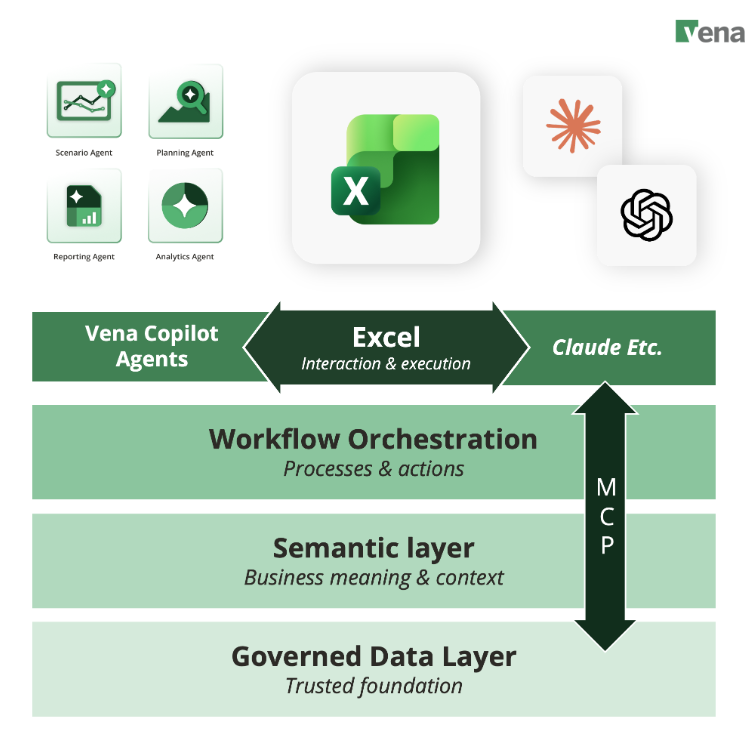
Image – Claude and Vena 1
What It Means for Your Organization
If you already use Vena as a platform for your planning processes, Claude doesn’t disrupt these processes but rather enhances them. You can spend less time on repetitive setup work of templates or formula troubleshooting and more on interpreting results and exploring what-if scenarios and simulations. AI becomes a productivity layer on top of an already trusted and structured planning environment. Because Vena remains the system of record, governance and auditability are not compromised: speed is added where it makes sense without sacrificing control.
For finance teams still operating entirely in Excel, the combination of Claude and Vena highlights an important shift: The biggest value to be unlocked from exciting AI tools like Claude, is combining it with a governed and trusted source of data. Claude shows how much faster and easier Excel‑based analysis can be. Vena addresses what happens when that analysis needs to scale across teams, cycles and stakeholders. Together they offer a measured path to modernization. Excel stays central, AI improves accessibility and speed and Vena provides structure, consistency and confidence in the numbers.
Conclusion
The real value of AI in finance is unlocked when speed is paired with trust.
Tools like Claude accelerate insight by making it easier for teams to explore data, test assumptions, and move quickly from questions to understanding. But speed alone isn’t enough. Without a governed foundation, insights risk becoming fragmented as they spread across the organization.
Vena provides that foundation. It ensures that once insights matter—when they inform plans, reports, and decisions—they remain consistent, auditable, and aligned to a single version of the truth.
Together, Claude and Vena give finance teams the ability to move faster without losing control. As business complexity increases, this balance becomes essential: rapid exploration supported by a system that keeps the organization aligned as insights turn into action.
Want to learn more about the power of combining Claude for Excel with Vena? Contact us today to schedule a free demo!
Or are you ready to test-drive Vena yourself to explore the full power and capabilities of the platform? Our ad-hoc Vena Interactive workshop is the ideal way to learn by yourself how Vena can bring value to your planning and reporting challenges. Start here: Empower Your Management Reporting with Vena for Excel (Interactive Workshop).
Read more about the general concepts of Vena:
Specific features of Vena:
- Introducing Vena for Microsoft PowerPoint
- Vena Copilot: Revolutionizing Finance with Agentic AI
- Enhancing Business Efficiency with Vena Solutions' Hybrid and Standalone Templates
Our pre-configured starter kits with Vena:
FAQ
Claude for Excel is an AI capability that works directly inside spreadsheets. It lets finance teams build financial models, create formulas, clean data, and explore scenarios conversationally. Instead of wrestling with complex formulas, users describe what they need, and Claude suggests model structures, reshapes datasets, and explains calculations, lowering the technical barrier to Excel without taking control away from the user.
While Claude makes Excel faster and more approachable, it doesn't automatically make it enterprise-ready. Claude works only with whatever data sits in the workbook; it doesn't decide where that data comes from or whether it matches how the organisation defines its numbers. Fragmentation, inconsistent structures and manual reconciliation remain. AI accelerates whatever environment it is placed in, but it doesn't turn spreadsheets into a governed planning system.
Vena Solutions is a financial planning and analysis (FP&A) platform that centralises budgeting, forecasting, reporting and financial data management. It extends Excel by connecting familiar spreadsheets to a governed, multi-dimensional data model where actuals, budgets and forecasts are managed consistently across the organisation. Finance teams keep working in Excel, but those spreadsheets become connected to a single source of truth rather than isolated files.
element61's approach pairs Claude's speed with Vena's governed foundation. When Claude operates inside a Vena-connected Excel environment, it works with spreadsheets that already follow consistent structures and are backed by trusted data. Instead of generating disconnected layouts, it helps create templates that align with how the organisation plans and reports. element61 can help you combine both; contact us.
In a standalone Excel environment without a central planning platform, familiar problems resurface. Data still lives in separate files, teams use slightly different structures, and planning cycles rely on manual coordination, email follow-ups, and reconciliation. Claude doesn't enforce consistency over time, so two people asking similar questions can receive different outputs, increasing speed but most likely increasing risk as well.
Claude reduces friction in many day-to-day FP&A activities. element61 highlights that analysts can work conversationally instead of staring at a blank grid; Claude suggests model structures, reshapes datasets, explains calculations, and supports quick scenario testing. This shortens the path from question to insight, makes early-stage analysis easier under time pressure, and lowers the technical barrier to working in Excel without removing user control.
Vena addresses the structural challenges that AI alone cannot solve. Planning logic is defined once and reused; inputs flow through structured workflows with clear ownership and visibility, and Vena remains the system of record, so governance and auditability are not compromised. Speed is added where it makes sense without sacrificing control, keeping every number aligned to a single version of the truth.
Finance and FP&A teams benefit most. Organisations already using Vena for planning gain a productivity layer: Claude enhances existing processes rather than disrupting them, so teams spend less time on repetitive template setup and formula troubleshooting and more on interpreting results and exploring what-if scenarios. Teams still working entirely in Excel gain a measured path to modernisation. We can guide that transition, contact us.
Together they combine speed with control. Excel stays central, Claude improving accessibility and speed, and Vena providing structure, consistency and confidence in the numbers. Analysts can move quickly, but what they build doesn't live in isolation; templates can be connected, reused, reviewed and operationalised. Ad hoc analysis no longer has to remain one-off when a useful insight needs to scale across teams and cycles.
element61 offers a free demo of Claude for Excel combined with Vena, plus an ad hoc Vena Interactive workshop where you can test-drive the platform on your own planning and reporting challenges. The biggest value from AI tools like Claude comes from combining them with a governed, trusted data source. Get in touch to schedule a demo.