


ESG reporting (Environmental, Social & Governance) is establishing a bigger foothold within many organisations. Regulations are ramped up globally due to increasing environmental, social and governance (‘ESG’) challenges. Europe’s Corporate Sustainability Reporting Directive (‘CSRD’) is a prime example of far-reaching regulation by targeting a significant proportion of businesses, whilst demanding a substantial level of detail in the reporting.
Companies are challenged by an increasing reporting burden as a consequence. Efforts and resources are freed up to enable the reporting. Auditing and verification processes ensure the reporting is validated. Operations require optimizations to steer ESG performance, which in turn requires detailed insights to be generated.
On the other hand, ESG can be viewed as a value-creation opportunity. A successful ESG business strategy can increase brand value and enable access to capital with favorable financing terms, manage operational risks, induce cost-savings, enhance stakeholder relations or drive product sales via certificates or energy labels.
In this whitepaper we give a pragmatic honest perspective to getting ESG reporting done first-time right leveraging what BI & CPM have learned us last 20 years.
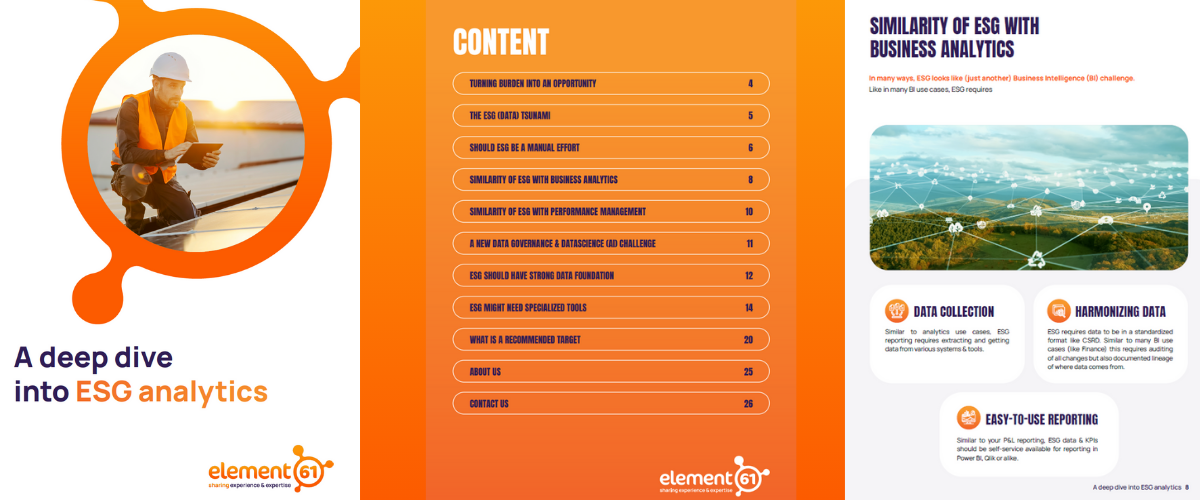
Here is what we cover in the whitepaper:
- Why the ESG topic is a (Data) Tsunami
- How we feel ESG shouldn't be a full manual effort
- Similarity of ESG with Business Analytics & Performance Management
- How Data Governance & even Gen(AI) have a role to play in ESG
- 3 Concrete recommended architectures we see using Microsoft Fabric, Microsoft Databricks & niche ESG tools like Greenomy, CCH Tagetik & the Microsoft Sustainability Platform

