Search

Customer Deduplication

IT
People & HR
Customer deduplication creates a single, reliable view of each customer.
By cleaning, matching, and merging customer records using a structured and automated process, duplicate profiles are combined into one master customer ID. This ensures consistent customer data across systems, accurate reporting, and more effective marketing and customer interactions.

Customer deduplication: building a single customer view

Many organizations struggle with the lack of a correct 360° customer view. The same customer often appears multiple times across databases due to spelling variations, inconsistent formatting, or the creation of new profiles without checking for existing ones. Over time, this leads to poor data quality and operational issues.

Duplicate customer records pollute the data:

  • Transaction history is spread across multiple profiles

  • Marketing campaigns target the same customer more than once

  • Customer insights and analytics become biased

  • Manual data cleaning takes significant time and effort

This not only frustrates internal teams but also results in a poor experience for customers.

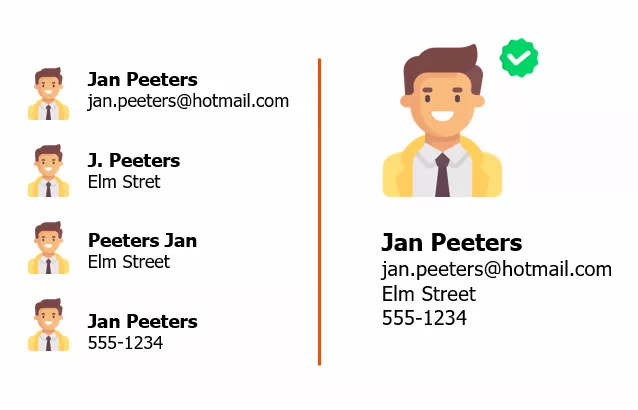
Customer deduplication addresses this by defining what makes a customer unique and enforcing it consistently.
The result is a clean customer table where duplicates are merged under a single customer ID and customer details are aligned across all related records.

Image
Customer deduplication example

A structured data cleaning and deduplication pipeline

Customer deduplication is implemented through a clear, repeatable pipeline, tailored to the client’s data and business rules:

  1. Data normalization
    Input attributes are cleaned and standardized. This includes actions such as standardizing street names, formatting names consistently, and validating values like age ranges or postal codes.

  2. Hard matching
    Strict matching rules are applied to identify exact duplicates, for example based on identical email addresses, customer numbers, or fully matching personal details.

  3. Soft matching
    Similarity-based comparisons are used to detect likely duplicates that are not exact matches. Configurable thresholds help identify records that are probably the same customer despite small differences or spelling errors.

  4. Data alignment
    Once records are linked, customer attributes are merged or prioritized according to predefined rules, ensuring consistent and reliable master data.

Efficient and scalable execution

The deduplication process at one of our fashion retail customers runs as an automated workflow, optimized for project-specific requirements and scheduled to run daily. It continuously detects new master customer combinations by processing:

  • Updates to existing customer records

  • Newly ingested customer data

By leveraging the scalable compute and storage capabilities of Microsoft Azure and Databricks, the solution handles large volumes of customer data efficiently while remaining flexible as data grows.

The outcome is a trusted, up-to-date customer foundation that supports accurate reporting, targeted marketing, and a better overall customer experience.

Market Basket Analysis

Inventory
Sales & Marketing
Product recommendations use customer and sales data to suggest relevant products at the right moment.
By analyzing past purchases and customer behavior, complementary products can be recommended across sales channels. This leads to higher cross-sell and up-sell rates, larger basket sizes, and a smoother sales process for both customers and sales teams.

Product recommendations: turning sales data into relevant suggestions

Product recommendation solutions help guide customers and sales teams toward the most relevant products based on real purchasing behavior. Instead of relying on intuition, recommendations are driven by data: what customers bought in the past, which products are frequently purchased together, and how buying patterns evolve over time.

This approach delivers clear business value:

  • Improved customer satisfaction through relevant suggestions

  • Higher cross-sell and up-sell rates

  • Increased average basket size

  • Reduced sales cycle time for sales teams

Recommendations can be used across channels: at checkout, in digital platforms, or by sales representatives during customer interactions.

How recommendations are generated

Recommendations are based on historical sales data and customer behavior. Different analytical methods can be applied depending on the use case and data maturity:

1. Association Rule Learning (Market Basket Analysis)

This method identifies products that are frequently bought together by analyzing past transactions. For example:

  • Tiles and glue appear together in 25% of all invoices (support).

  • Every tile purchase includes glue (confidence = 100%).

  • Half of glue buyers also purchase tiles.

These insights form the basis for cross-sell recommendations such as suggesting glue when tiles are added to the basket.

Image
Recommendation

2. Recommendation systems

This approach looks at average customer behavior:

  • What products are usually bought together?

  • What did similar customers purchase?

Customers are then shown products that people “like them” often buy, making recommendations more relevant and easier to accept.

3. Predictive modeling

Predictive models estimate the likelihood that a customer will buy a specific product, given their previous purchases. This allows for more targeted recommendations and prioritization of products with the highest chance of conversion.

Practical use cases

  • Suggest complementary products at checkout

  • Help sales representatives propose frequently paired items

  • Enable data-driven cross-selling based on actual buying behavior

Output and delivery

The result is a dynamic recommendation table that lists relevant product combinations and their associated recommendations. This output updates automatically when new orders are placed or when the data is refreshed, ensuring recommendations remain current and accurate.

Image
Market Basket Analysis

By grounding product recommendations in real transaction data, organizations can systematically increase revenue while making it easier for customers to find what they actually need.

Web Personalization

Sales & Marketing
Web personalization uses customer data to show the right content to the right user at the right time.
By combining behavioral tracking with a customer data platform (CDP), digital channels can deliver personalized content, product recommendations, and targeted campaigns, improving user experience while enabling up- and cross-selling.

Web personalization: creating relevant digital experiences

Web personalization focuses on delivering a tailored user experience across digital platforms such as websites and portals. Instead of showing the same content to every visitor, users see information, recommendations, and messages that are relevant to their profile, behavior, and needs.

This enables:

  • More relevant content for each user

  • Targeted marketing campaigns

  • Up- and cross-selling opportunities

  • A clearer, more intuitive user experience

The challenge: limited customer insight

Many organizations struggle to personalize their digital platforms because:

  • Past user behavior is not tracked or stored

  • There is no user-level behavioral data

  • Technology to capture and activate this data is missing

  • There is no clear personalization strategy

As a result, all users see the same content, often leading to information overload and missed commercial opportunities.

From generic to personalized: a structured approach

Web personalization starts with building a Customer 360° view by collecting and unifying behavioral and profile data:

  1. Tracking user behavior
    The right tools and tracking mechanisms (such as cookies and event tracking) are installed to capture user interactions on the website.

  2. Unifying data in a Customer Data Platform (CDP)
    A CDP is used to store and combine real-time behavioral data with customer and profile information, creating a single, consistent view of each user.

  3. Data activation
    Based on this unified data, personalized content is pushed to specific users or segments. This includes content recommendations, targeted campaigns, and personalized page elements.

Image
CDP

Concrete example: personalized content at profile level

Consider a user logged into a digital platform. Based on their profile and past behavior:

  • Only relevant documents are shown on their dashboard

  • Irrelevant or overly complex information is hidden

  • Content adapts to their needs without overwhelming them

This ensures users quickly find what they need, while the platform remains focused and easy to navigate.

Image
Personalization example

Result: better experience and better outcomes

By implementing web personalization supported by a CDP, organizations move from static websites to dynamic digital experiences. Users receive relevant content, marketing becomes more effective, and digital channels become a direct driver of engagement and revenue.

Geo Dashboarding

Sales & Marketing
Geo dashboarding gives B2B sales and marketing teams a clear, data-driven view of where their best prospects are located.
By combining internal sales data, external company and employee data, and geographic information, potential customers are identified and visualized on an interactive map. This enables targeted prospecting, better alignment between teams, and more focused sales efforts across regions.

Geo dashboarding: data-driven B2B prospecting by region

Geo dashboarding supports B2B marketing and sales teams in identifying and prioritizing prospecting opportunities across different geographic regions. Instead of working with fragmented data or intuition, teams gain a clear visual overview of where potential customers are located and where sales efforts will have the most impact.

The challenge: prospecting without direction

At NMBS, the B2B team is responsible for closing contracts with companies to provide train subscriptions for employees’ daily work commutes. However, several challenges limited their effectiveness:

  • Low data maturity: limited insight into current performance and market potential

  • Lack of internal alignment: no shared view on priorities or regional focus

  • Inefficient prospecting: no clear guidance on which companies to target

Without data insights or visual overviews, the B2B growth strategy felt like prospecting in the dark.

A data-driven approach to geographic prospecting

Geo dashboarding addresses these challenges by combining multiple data sources into one actionable view:

  • Internal sales and customer data

  • External data sources such as RSZ/ONSS

  • Geographic data on office and employee locations

An algorithm enriches and matches these datasets to identify potential B2B prospects and align them with ongoing sales efforts.

From raw data to actionable insights

Using this approach:

  • Over 4 million employees were mapped to their office locations

  • The share of employees with a feasible train commute was calculated, based on whether train travel time is equal to or faster than driving

  • Current versus potential train commute adoption was calculated per company and per region

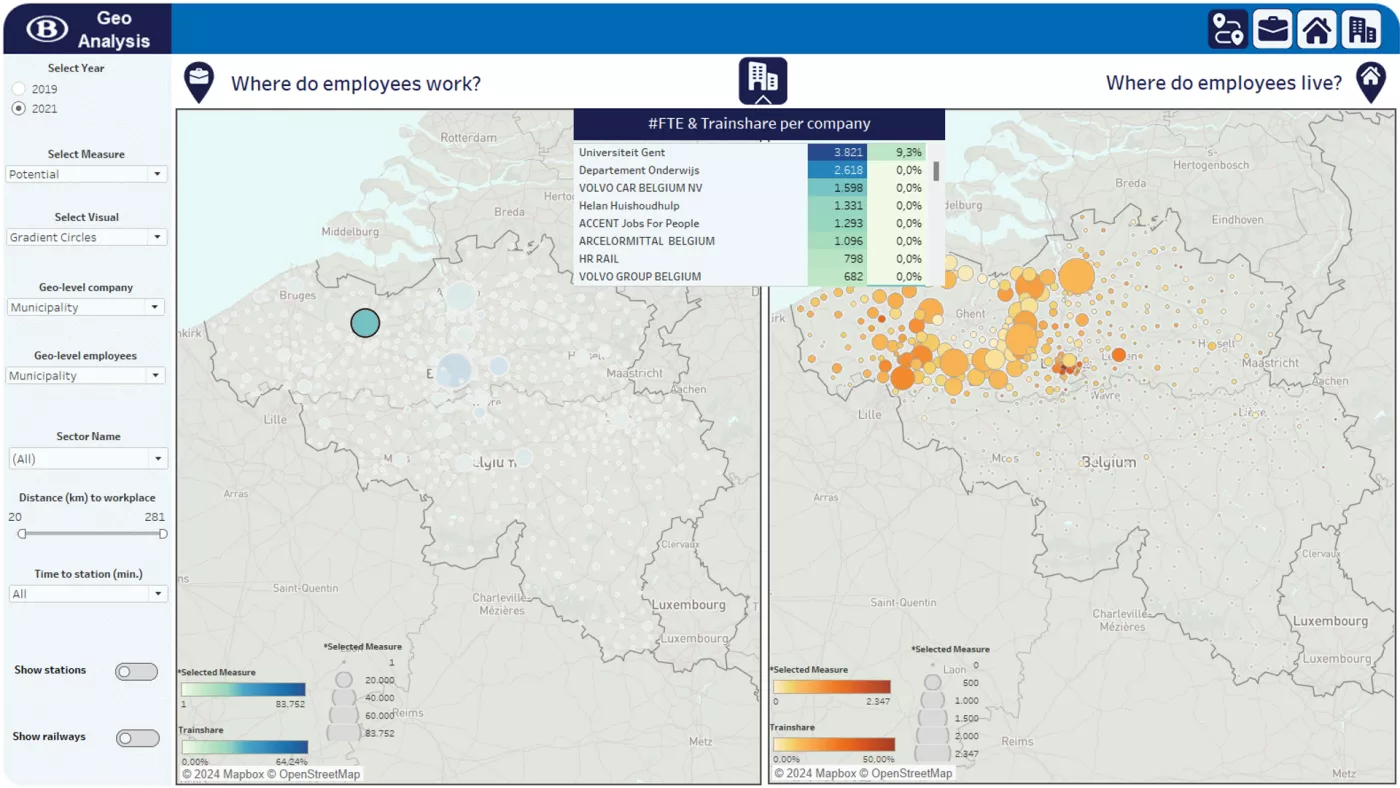
These insights are then visualized in an interactive geographic dashboard, showing:

  • Where NMBS already has strong penetration

  • Where untapped potential exists

  • Which regions and companies should be prioritized by sales team

Image
NMBS dasbhboard

Result: focused outreach and better alignment

By visualizing prospecting opportunities geographically, B2B teams can focus their outreach on companies with the highest potential, align sales and marketing around the same insights, and move from reactive to targeted, data-driven prospecting.

Contract Renewal

Sales & Marketing
Contract renewal analytics help predict which customers will renew their fixed-term contracts and when.
By using predictive models, companies can proactively engage the right customers at the right moment, improve sales planning, reduce churn, and make revenue from renewals more predictable.

Contract renewal: predicting renewals and timing

For companies offering fixed-term leasing contracts, understanding whether customers will renew and when is critical. As contract end dates approach, uncertainty often remains about customer intentions. This makes it difficult to plan sales activities, allocate resources efficiently, and retain customers.

Without clear insight into renewal behavior, organizations face several challenges:

  • Missed renewal opportunities

  • Inefficient sales planning and misdirected dealer efforts

  • Higher customer churn

  • Unpredictable renewal revenue

As one finance manager put it:
“How can we predict which leasing customers will renew and when so dealers can contact the right customer at the right time?”

A predictive, data-driven renewal process

Contract renewal analytics address this challenge by using historical contract, customer, and behavior data to build a predictive model that estimates:

  • The likelihood that a customer will renew their contract

  • The expected timing of that renewal

This shifts the renewal process from reactive follow-ups to a proactive, structured approach.

Image
Contract renewal

Turning predictions into action

The model outputs are directly usable by sales and service teams:

  • Dealers can prioritize customers with the highest renewal likelihood

  • Customers are contacted at the optimal moment, based on predicted timing

  • Sales resources are allocated more efficiently across the customer base

Business impact

This data-driven approach delivers clear benefits:

  • Proactive customer engagement instead of last-minute outreach

  • More efficient use of sales and service capacity

  • Reduced customer churn

  • Better visibility into renewal behavior and customer lifecycle patterns

Image
Mazda Example

By transforming contract renewals into a strategic, insight-driven process, organizations improve both operational efficiency and long-term customer retention, while making renewal revenue more predictable.